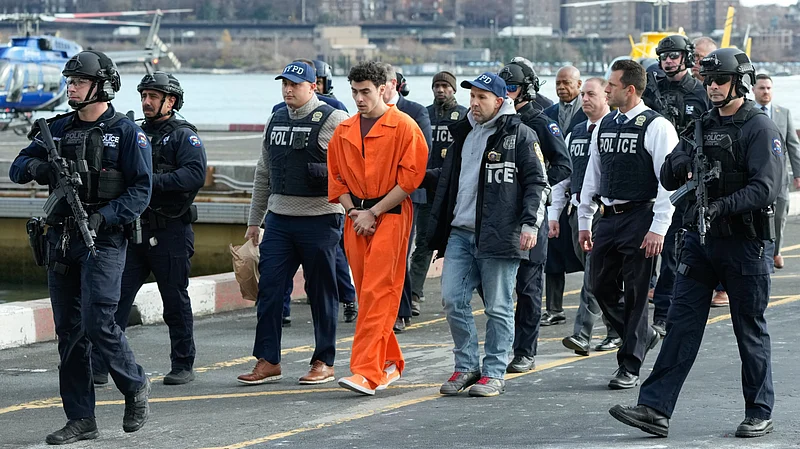

On August 14, 2026, Luigi Nicholas Mangione stood before U.S. District Judge Margaret M. Garnett in a Manhattan federal courtroom and admitted to a calculated act that shocked the nation. Before the court, Luigi Mangione enters guilty plea for the killing of Brian Thompson, confessing under oath that he stalked and murdered the UnitedHealthcare CEO on a busy Manhattan street in December 2024. The 28-year-old from Maryland spoke clearly: “The morning of December 4, 2024, I shot Mr. Thompson in Manhattan and he is dead.”
However, this guilty plea has triggered an unexpected legal battle. While federal prosecutors now seek life imprisonment, Mangione’s defense attorneys argue their client should not face punishment twice for the same conduct. As a result, the state murder trial, originally scheduled to begin September 8, 2026, has been postponed indefinitely as courts wrestle with complex double jeopardy questions.
The case has captivated public attention not only because of the brazen nature of the crime but also because of what it revealed about American frustration with healthcare systems. In fact, Thompson’s death became emblematic of broader societal tensions, although law enforcement officials have been clear: no grievance justifies murder.
What Happened to Brian Thompson?

How Did Luigi Mangione Kill Brian Thompson?
Brian Thompson, 50, served as Chief Executive Officer of UnitedHealthcare, one of America’s largest health insurance providers. On the morning of December 4, 2024, he was scheduled to attend an investor conference at a Midtown Manhattan hotel.
However, Thompson never made it inside.
According to federal court documents and statements from U.S. Attorney Jamie McDonald, Mangione had spent more than a week in New York City preparing for the attack. During this time, he conducted surveillance on locations Thompson frequented, including the hotel where the CEO was staying. At approximately 6:45 a.m., as Thompson approached the conference venue, Mangione positioned himself nearby and waited.
When Thompson arrived, Mangione approached from behind. Without warning, he fired multiple shots at close range. As a result, Thompson collapsed on the sidewalk outside the hotel. Despite emergency response efforts, he was pronounced dead shortly after.
Meanwhile, Mangione immediately fled the scene, disappearing into the city. In response, the New York Police Department launched an intensive manhunt, releasing surveillance footage that would ultimately lead to his capture.
Timeline of the Brian Thompson Murder Case
December 2024: Planning and Execution
Months Before December 4, 2024: Mangione developed his plan to kill Thompson. According to federal prosecutors, he specifically targeted Thompson because of his role as CEO of UnitedHealthcare. In addition, the motive appeared connected to Mangione’s own struggles with severe back pain and his frustrations navigating the health insurance system.
Late November 2024: Mangione traveled from outside New York to New York City. For this journey, he used interstate bus services to cross state lines, a detail that would later become legally significant in federal charges.
November 26-December 3, 2024: For more than a week, Mangione stayed at a New York City hostel that served interstate travelers. During this time, he conducted surveillance operations, tracking Thompson’s movements and identifying patterns.
December 4, 2024, 6:45 a.m.: Mangione shot and killed Brian Thompson outside a Midtown Manhattan hotel. Significantly, the attack occurred in broad daylight on a busy street.
December 2024: The Manhunt
December 4-9, 2024: Law enforcement agencies coordinated an intensive search. In response to the killing, the NYPD released surveillance images showing the suspect. Subsequently, news coverage spread the photos nationwide.
December 9, 2024: A McDonald’s employee and customer in Altoona, Pennsylvania, recognized Mangione from the widely circulated photos. After recognizing him, they contacted local police. When officers arrived and arrested Mangione, they discovered he was carrying a false driver’s license that matched one he had used while in New York City. Additionally, law enforcement recovered a firearm and other evidence linking him directly to Thompson’s murder.
2025-2026: Dual Prosecutions
December 2024 – Early 2025: Mangione faced Pennsylvania charges related to the weapons and fraudulent identification found during his arrest. Meanwhile, both New York state prosecutors and federal prosecutors prepared separate cases.
State Charges: Manhattan District Attorney Alvin Bragg brought charges including second-degree murder and weapons offenses. In response, Mangione pleaded not guilty to these charges. If convicted, he faced 25 years to life in prison.
Federal Charges: The U.S. Attorney’s Office for the Southern District of New York charged Mangione with interstate stalking resulting in death and cyberstalking through use of interstate facilities resulting in death. Notably, both charges carried maximum sentences of life imprisonment.
August 14, 2026: Mangione appeared before Judge Margaret M. Garnett in federal court. During the hearing, he pleaded guilty to both federal stalking charges. Following the plea, prosecutors Jamie McDonald confirmed the government would seek life imprisonment at sentencing.
August 16, 2026: Mangione’s defense attorneys filed an emergency motion with New York State Justice Gregory Carro, arguing that the state charges must be dismissed on double jeopardy grounds. In their motion, they contended that federal and state prosecutors were attempting to punish their client twice for identical conduct.
August 17, 2026: Judge Carro issued a brief written order postponing the state trial. Through this order, he gave prosecutors until October 9, 2026, to respond to the double jeopardy motion. In addition, a hearing was scheduled for December 10, 2026.
December 18, 2026: Mangione’s federal sentencing is scheduled before Judge Garnett.
Who Is Luigi Mangione?

Luigi Nicholas Mangione is a 28-year-old man from Maryland. According to court statements, he suffered from severe chronic back pain that significantly impacted his quality of life. During his guilty plea hearing, Mangione told the court he experienced difficulties “navigating the obstacles of the health insurance system and witnessing similar experiences of countless others.”
These frustrations appear to have radicalized him toward violence. However, U.S. Attorney Jamie McDonald was emphatic in his statement: “No grievance, political belief, or ideological cause can justify murder.”
Disturbingly, Mangione developed a following on social media after his arrest. For example, some individuals portrayed him as a folk hero fighting against corporate healthcare interests. In response, NYPD Commissioner Jessica S. Tisch addressed this directly: “To those who idolize Mangione, violence is not a cause, murder is not a message, and a killer is not a hero.”
What Charges Did Luigi Mangione Face?
Federal Charges: Interstate Stalking
Mangione pleaded guilty to two federal counts:
- Interstate stalking resulting in death: This charge stemmed from Mangione’s use of interstate travel and communications to stalk Thompson before killing him.
- Cyberstalking through use of interstate facilities resulting in death: This addressed Mangione’s use of phones, internet, and other interstate systems in planning the murder.
Both charges carry maximum sentences of life in prison. Although federal sentencing guidelines typically recommend 24 to 30 years, prosecutors have indicated they will argue for life imprisonment.
State Charges: Second-Degree Murder
The Manhattan District Attorney charged Mangione with:
- Second-degree murder: Carries 25 years to life in prison
- Multiple weapons offenses: Related to the firearm used in Thompson’s killing
Mangione pleaded not guilty to all state charges. However, as a result of his federal guilty plea, his attorneys now argue these state charges violate New York’s double jeopardy protections.
Why Was Luigi Mangione’s State Trial Postponed?
What Is Double Jeopardy and Does It Apply Here?
New York state law prohibits prosecuting someone twice for the same criminal conduct. Importantly, this protection is broader in New York than in federal law or in most other states. After Mangione’s guilty plea in federal court, his defense team immediately filed motions arguing that continuing with the state murder trial would constitute unconstitutional double jeopardy.
In their filings, defense attorneys described their client as a “pawn in parallel prosecutions,” claiming state and federal prosecutors coordinated to “punish him twice for the exact conduct.”
Nevertheless, legal experts suggest this argument faces significant hurdles. For example, Bennett Gershman, a law professor at Pace University in New York, explained that New York’s double jeopardy law contains exceptions for crimes with different legal elements or aimed at preventing “very different kinds of harm or evil.”
The federal stalking charges require proof of intent to kill but do not require that death actually occur. In contrast, the state murder charges require proof that death resulted from Mangione’s actions. According to Gershman, “The elements in stalking and the elements of murder are very, very distinguishable.”
Additionally, Manhattan prosecutors emphasized in court filings that Mangione has not yet been sentenced in federal court. Because the punishment remains unknown, they argue double jeopardy protections have not yet been triggered.
Judge Carro gave prosecutors until October 9, 2026, to file a full response to the defense motion. Following this deadline, a hearing will be held December 10, 2026, just eight days before Mangione’s federal sentencing.
What Did Law Enforcement Say About the Case?
NYPD and FBI Coordination
The investigation showcased extraordinary coordination between local and federal law enforcement. For instance, NYPD Commissioner Jessica S. Tisch praised her detectives for “pairing sophisticated technology with painstaking, old-fashioned police work to identify the suspect and build the case.”
The surveillance footage released by the NYPD proved crucial. Within days, the images had spread nationwide. When Mangione walked into a McDonald’s in Altoona, Pennsylvania, employees immediately recognized him.
Meanwhile, FBI Assistant Director in Charge James C. Barnacle, Jr. acknowledged the family’s grief: “While nothing can ease the family’s grief, we hope this brings them one step closer to closure.”
In addition, U.S. Attorney Jamie McDonald framed the case in broader terms: “With today’s guilty plea, Mangione is being held accountable for a heinous crime that claimed an innocent life and drew national attention.”
Could Luigi Mangione Face Consecutive Sentences?
If Judge Carro denies the double jeopardy motion and the state trial proceeds, Mangione could theoretically face consecutive sentences in both cases. In the federal case, prosecutors are seeking life imprisonment. In the state case, prosecutors would seek 25 years to life if he were convicted of murder.
Consecutive sentences would mean Mangione serves both sentences one after another, effectively guaranteeing he dies in prison. However, if the state charges are dismissed, only the federal life sentence would apply.
The outcome of the December 10 hearing before Judge Carro will determine whether this possibility remains on the table. Regardless of Carro’s decision, whatever he decides can be appealed, potentially extending litigation for months or years.
What Happens Next in the Mangione Case?
Key Upcoming Dates
October 9, 2026: Deadline for Manhattan prosecutors to respond to the defense’s double jeopardy motion.
December 10, 2026: Hearing before Judge Carro on the motion to dismiss state charges. Significantly, this hearing occurs just eight days before federal sentencing.
December 18, 2026: Mangione will be sentenced in federal court before Judge Margaret M. Garnett. As previously stated, federal prosecutors have confirmed they will request life imprisonment, the maximum sentence allowed.
If Judge Carro dismisses the state charges, December 18 will likely mark the final chapter in Mangione’s criminal proceedings. However, if Carro denies the motion, the state murder trial could proceed sometime in 2027, though the defense would almost certainly appeal any adverse ruling.
Why This Case Matters Beyond One Murder
The killing of Brian Thompson exposed deep frustrations many Americans feel toward the healthcare industry. At the time of his death, Thompson led one of the country’s largest health insurers at a time when medical debt, claim denials, and coverage disputes dominate public discourse.
After Mangione’s arrest, disturbing online communities emerged celebrating him as a symbol of resistance against corporate power. For example, some social media users posted messages praising violence against healthcare executives. In addition, others created merchandise featuring Mangione’s image.
However, law enforcement officials condemned this response unequivocally. Commissioner Tisch’s statement bears repeating: “Violence is not a cause, murder is not a message, and a killer is not a hero.”
Broader Implications for Society
The case raises uncomfortable questions about how societal frustrations can metastasize into violence when individuals feel powerless through legitimate channels. While systemic healthcare problems deserve serious attention and reform, targeting individuals with violence represents a complete moral and legal failure.
Thompson was a husband, father, and professional who believed he was contributing positively to healthcare delivery. Whatever one’s views on insurance companies, his murder solved nothing and caused immeasurable suffering to his family and colleagues.
Stay informed about the latest developments in high-profile criminal cases like this one. Subscribe to our Crime and Psyche YouTube channel for in-depth analysis, case updates, and thoughtful discussions about the psychology behind criminal behavior. We examine not just what happened, but why it happened and what it reveals about human nature, societal pressures, and warning signs we all should recognize.
Sources
- U.S. Attorney’s Office, Southern District of New York – Press Release
- The Guardian – Luigi Mangione New York Murder Trial Postponed
- New York Police Department
- Federal Bureau of Investigation
- Reuters reporting on legal proceedings
- Il Post and Euronews international coverage
- Washington Examiner court reporting
A System Failed, But Murder Is Never the Answer
Luigi Mangione’s guilty plea brings a measure of legal resolution to a case that gripped the nation and exposed uncomfortable truths about American healthcare frustrations. Despite this legal closure, Brian Thompson’s family will never get him back. As a harsh reality, no sentence can restore what was taken from them on that December morning.
As this case moves toward final sentencing in December 2026, the legal questions about double jeopardy and parallel prosecutions may consume courtroom attention. Although those questions matter for precedent and fairness in our justice system, the deeper questions remain unanswered.
For example, how do we as a society address legitimate grievances about healthcare access, insurance practices, and medical debt without allowing frustration to curdle into violence? In addition, how do we prevent vulnerable, isolated individuals from radicalizing toward murderous action?
Thompson’s death should prompt reflection about systemic healthcare reform. However, it should never be celebrated as justified resistance. Ultimately, Mangione made a choice to stalk and kill another human being. As U.S. Attorney McDonald stated, that choice cannot be justified by any grievance, ideology, or political belief.
The investigation by the NYPD, FBI, and partner agencies demonstrated how modern law enforcement combines technology with traditional detective work. Within five days, they identified, located, and arrested the suspect in another state. Subsequently, justice moved forward methodically through the legal system.
As Mangione awaits sentencing, Brian Thompson’s family continues grieving a loss that never should have occurred. In the end, their pain reminds us that behind every headline is a human story, a family shattered, and a life cut short by violence that solved nothing.