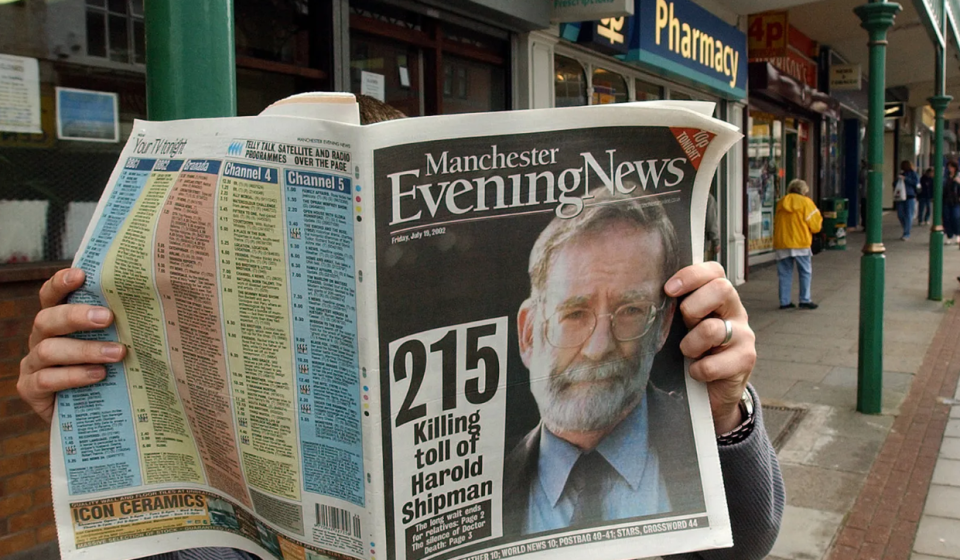

By the time anyone started asking the right questions, Dr. Harold Frederick Shipman had already murdered at least 215 people. The doctor of death was one of Britain’s most deadliest serial killers. Over nearly three decades, Dr Harold Shipman killed the patients who trusted him most. However, he was not a shadowy figure lurking in dark alleys. Instead, he was the most trusted man in Hyde, Greater Manchester. He made house calls, remembered your name, and sat with you when you were scared. Then he killed you.
Between 1975 and 1998, Shipman systematically murdered an estimated 250 patients, primarily elderly women. He injected them with lethal doses of diamorphine, signed their death certificates himself, and falsified medical records to cover his tracks. Meanwhile, his victims’ families grieved what they believed were natural deaths. As a result, the trust placed in a family doctor became his deadliest weapon.
What makes this case uniquely terrifying is how perfectly Shipman hid within the system. He controlled every aspect of patient care, death certification, and record-keeping. Therefore, the very structures designed to protect patients became tools for murder. In addition, his crimes raise haunting questions about medical oversight, professional trust, and how such evil can hide behind a veneer of compassion.
Who Was Harold Shipman and How Did His Killing Begin?
Harold Frederick Shipman was born on January 14, 1946, in Nottingham, England. Growing up on the Bestwood Estate, a council estate, he was the son of Vera Brittan Shipman and Harold Frederick Shipman Sr., a lorry driver. His parents were devout Methodists. However, no one in his working-class family had attended university before him.
Shipman’s childhood appeared unremarkable until tragedy struck. When he was 17, his mother Vera was diagnosed with lung cancer at just 43 years old. During her final months, doctors came to their home to administer morphine injections for pain relief. Meanwhile, Harold watched closely as needles brought his mother temporary relief from suffering. On June 21, 1963, Vera Shipman died. Two years later, Harold enrolled at Leeds School of Medicine, University of Leeds.
Whether watching his mother’s morphine treatments planted something dark in him remains debated. However, the parallel is impossible to ignore. Shipman chose to become the person who comes to the home with the needle. After graduating from Leeds in 1970, he began working as a junior doctor at Pontefract General Infirmary.
When Did the First Warning Signs Appear?
The first red flag emerged quickly. In 1974, Shipman became a GP at the Abraham Ormerod Medical Centre in Todmorden, West Yorkshire. Within a year, however, authorities discovered he had been forging prescriptions for pethidine, a powerful opiate painkiller, for his own use. As a result, he had developed a serious addiction.
In 1975, authorities convicted and fined Shipman £600 (equivalent to approximately £4,660 today). He briefly attended a drug rehabilitation clinic in York. Although the General Medical Council issued him a warning, it did not ban him from practicing medicine. This decision would prove catastrophic. Despite his conviction, he was allowed to continue his career with barely a pause.
By 1977, Shipman had secured a new position at Donneybrook Medical Centre in Hyde, Greater Manchester. A fresh start in a new town. Over the following years, he carefully built a reputation as an exceptional, dedicated doctor. He made house calls, showed warmth with patients, and developed such a strong following that people requested to be registered specifically with him.
In 1993, Shipman opened his own solo practice at 21 Market Street in Hyde. By every observable measure, he was exactly the doctor families wanted. Meanwhile, the killings had almost certainly already begun. The Shipman Inquiry later concluded that Eva Lyons, aged 70, was likely his first victim. He killed her on March 17, 1975, the day before her 71st birthday, while working in Todmorden.
How Did Harold Shipman Murder His Patients?
Shipman’s method was chillingly simple because of its effectiveness. He targeted primarily elderly women who lived alone or whose deaths would seem unsurprising given their age. During afternoon rounds, he would visit patients at home. Then he would administer a lethal dose of diamorphine, the pharmaceutical name for medical-grade heroin, by injection.
After they died, he would contact the family to inform them their loved one had “passed peacefully.” As the attending physician, he signed the death certificate himself, attributing death to natural causes, heart failure, or old age. Subsequently, he would access the patient’s medical records and add fabricated entries. These invented illnesses or symptoms had never existed but made a sudden death appear as the predictable conclusion of a long decline.
In many cases, Shipman recommended cremation. This permanently eliminated the possibility of future toxicology examination. Because he controlled every layer of the process,as the doctor, certifier, and record-keeper,he knew exactly which layers mattered and how to manipulate them.
Why Did Nobody Stop Him Sooner?
This question haunts everyone who has studied the case. Although multiple people noticed suspicious patterns across multiple years, the system failed to act almost every single time.
Local undertakers observed that Shipman’s patients died at a strikingly high rate compared to other GPs in the area. One neighboring practice recorded his patient death rate as nearly ten times their own. John Shaw, a taxi driver, grew so suspicious after repeatedly driving elderly patients to appointments only to learn they had died shortly afterward that he personally went to police in 1998. When Shaw contacted authorities, he told them he believed Shipman had killed at least 21 patients.
Most significantly, in March 1998, Dr. Linda Reynolds, a fellow GP at the Brooke Surgery in Hyde, formally reported her concerns to John Pollard, the local coroner. Because she had noticed the unusually high volume of cremation forms for elderly women that Shipman had been asking colleagues to countersign, she felt compelled to act. As a result, Greater Manchester Police launched an investigation.
Police reviewed records and spoke to a medical adviser. However, in April 1998, they closed the case. Authorities concluded there was insufficient evidence to proceed. The Shipman Inquiry later found that inexperienced officers had been assigned to the case. Furthermore, the investigation had been fundamentally inadequate. After authorities shut down the case, Shipman murdered three more people.
What Finally Led to Harold Shipman’s Arrest?
Kathleen Grundy was 81 years old, a former mayoress of Hyde, and one of the most active, beloved members of her community. She volunteered regularly, served on charitable boards, and was known throughout the town. On June 24, 1998, she visited Shipman’s surgery for what seemed like a routine appointment. After returning home, she was dead within hours.
Shipman signed her death certificate, recording the cause as “old age.” Nobody initially questioned this. After all, she was 81. However, Shipman made one catastrophic error with Kathleen Grundy. In an uncharacteristic move, he got greedy.
A will surfaced claiming to be in Grundy’s name. It left her entire estate, worth approximately £386,000 (around $525,000 at the time), to Dr. Harold Shipman. When her daughter, Angela Woodruff, a solicitor herself, was informed by fellow solicitor Brian Burgess that this will existed and that it excluded her and her children entirely, Woodruff immediately knew something was wrong. The language was odd, the typing was crude, and the signature looked forged.
Angela Woodruff went straight to the police. Subsequently, authorities exhumed Kathleen Grundy’s body. Toxicology found a fatal concentration of diamorphine in her system, far beyond any legitimate medical explanation. When detectives examined Shipman’s computer records, they found notes claiming Grundy had been a drug user. However, the computer’s metadata proved he had added these entries after her death.
As a result, police launched a wider investigation. More bodies were exhumed. More toxicology reports came back with the same horrifying results: lethal diamorphine. In addition, investigators found stacks of old patient records at Shipman’s home. They found the typewriter he had used to forge Grundy’s will. After nearly three decades of operating in plain sight, the pattern finally became undeniable.
Authorities arrested Harold Shipman on September 7, 1998.
The Trial: What Were the Charges and Convictions?
Shipman’s trial opened at Preston Crown Court on October 5, 1999. Prosecutors charged him with murdering fifteen women by lethal injections of diamorphine between 1995 and 1998. The victims were:
- Marie West, 81
- Irene Turner, 67
- Lizzie Adams, 77
- Jean Lilley, 59
- Ivy Lomas, 63
- Muriel Grimshaw, 76
- Marie Quinn, 67
- Kathleen Wagstaff, 81
- Bianka Pomfret, 49
- Norah Nuttall, 65
- Pamela Hillier, 68
- Maureen Ward, 57
- Winifred Mellor, 73
- Joan Melia, 73
- Kathleen Grundy, 81
Throughout the entire proceedings, Shipman maintained his innocence. Composed and saying nothing of substance, he sat in the dock. Meanwhile, his wife, Primrose Shipman, attended every single day of the trial. In unwavering support, she sat in the public gallery.
On January 31, 2000, after six days of deliberation, the jury found Shipman guilty on all fifteen counts of murder and one count of forgery. Mr Justice Forbes sentenced him to life imprisonment on all fifteen counts with a whole life tariff. As a result, this meant he would never leave prison. In addition, he received a concurrent sentence of four years for forging Grundy’s will.
Eleven days later, on February 11, 2000, the General Medical Council struck Shipman from the medical register. He could never practice medicine again.
The Shipman Inquiry: How Many People Did He Really Kill?
Fifteen convictions were never the full picture. Because the scope of Shipman’s crimes remained unclear, the British government commissioned a comprehensive independent inquiry chaired by Dame Janet Smith to examine every death Shipman had ever certified. After lasting two years, the inquiry produced findings that shocked the world.
The Shipman Inquiry, published in 2005, confirmed that Shipman had killed an estimated 250 people. The earliest suspected case dated back to 1971, when he was still a junior doctor in training. Therefore, this means he may have been murdering patients for nearly 30 years.
The inquiry identified 215 confirmed unlawful killings. Additionally, there remained real suspicion about 45 other deaths. These were cases where evidence was insufficient for definitive conclusions but where circumstances raised serious concerns.
In addition, the inquiry concluded that the system had failed at multiple levels. Warning signs had been dismissed or ignored. Furthermore, the 1998 police investigation had been grossly mishandled. The structures designed to protect patients had catastrophically failed because existing medical oversight had been wholly inadequate to detect what Shipman was doing.
Who Were Harold Shipman’s Victims?
The vast majority of Shipman’s victims were elderly women. These were women who had lived full lives, raised families, served their communities, and grown old in the town they called home. Despite being in reasonably good health right up until the day Shipman came to visit, many were murdered without warning.
The fifteen women he was convicted of murdering represent just a fraction of his victims. However, their names and stories matter:
Marie West, Irene Turner, Lizzie Adams, Jean Lilley, Ivy Lomas, Muriel Grimshaw, Marie Quinn, Kathleen Wagstaff, Bianka Pomfret, Norah Nuttall, Pamela Hillier, Maureen Ward, Winifred Mellor, Joan Melia, and Kathleen Grundy.
The youngest was Bianka Pomfret, who was just 49 years old. Three of them were 81 years old. These were not people expected to die imminently. Instead, these were people with afternoon plans, families waiting for them, and cups of tea going cold on their kitchen tables.
Beyond these fifteen, hundreds more names exist. For example, Eva Lyons, believed to be his first victim in 1975. Countless elderly women in Todmorden and Hyde had their deaths signed off as natural. As a result, their families never knew the truth. Because many graves were never exhumed, many questions will never be answered.
What Happened to Harold Shipman in Prison?
After his conviction, authorities initially sent Shipman to HM Prison Durham before transferring him to HM Prison Wakefield in West Yorkshire. Wakefield is a high-security facility long known in the British press as “Monster Mansion” because it houses some of the country’s most dangerous criminals.
In 2002, Home Secretary David Blunkett confirmed the judge’s whole life tariff. This happened just months before British government ministers lost their power to set minimum terms for prisoners. Therefore, Shipman would never be released. Although authorities could have brought many additional charges, they concluded that a fair hearing would be impossible given the enormous publicity. Furthermore, the 15 life sentences already imposed rendered further litigation unnecessary.
While imprisoned, Shipman reportedly became friends with fellow serial killer Peter Moore. Despite overwhelming evidence against him, Shipman consistently denied his guilt and disputed the scientific evidence. He never made any public statements about his actions or motives.
Although Primrose Shipman maintained that her husband was not guilty, even after his conviction, she visited him almost daily. However, according to reports, she eventually began to suspect the truth. Because Shipman’s refusal to participate in courses acknowledging his crimes led to a temporary removal of privileges, this included the right to telephone his wife.
During this period, according to Shipman’s cellmate, he received a letter from Primrose urging him: “Tell me everything, no matter what.”
How Did Harold Shipman Die?
On January 13, 2004, one day before his 58th birthday, staff found Harold Shipman dead in his cell at HM Prison Wakefield. Using bedsheets tied to the bars of his window, he had hanged himself. Despite careful observation, he gave no obvious warning signs about his intentions.
The Medico Legal Centre in Sheffield performed a post-mortem examination. Subsequently, an inquest was opened. Although a 2005 inquiry found that Shipman’s suicide “could not have been predicted or prevented,” it recommended that procedures should be re-examined.
Shipman’s motive for suicide was never established. However, he reportedly told his probation officer that he was considering it to ensure his wife’s financial security. As a result, Primrose Shipman received a full NHS pension that she would not have been entitled to if Shipman had lived past age 60. Therefore, his suicide ensured she would be financially provided for.
After his death, authorities released Shipman’s body to his family. It remained in Sheffield for more than a year. Because police advised his widow against burying him in case the grave was attacked, he was eventually cremated at Hutcliffe Wood Crematorium in Sheffield. Only Primrose and their four children attended.
Current Status: What Reforms Followed the Shipman Case?
The Shipman case fundamentally changed British medical practice. The reforms that followed are now referred to as “the Shipman effect.” These changes aimed to ensure that no doctor could ever again use their position to murder patients on such a scale.
Death certification practices were completely overhauled. Previously, a single doctor could sign a death certificate with minimal oversight. However, now additional scrutiny applies, particularly for deaths not preceded by clear terminal illness. In addition, cremation forms require more rigorous countersigning by independent physicians.
The General Medical Council faced intense scrutiny. Although the Shipman Inquiry recommended fundamental changes to the GMC’s structure and oversight capabilities, the GMC itself was not abolished. However, its procedures for monitoring doctors, investigating complaints, and responding to concerns were significantly strengthened.
Controlled drug monitoring was enhanced. Because Shipman had stockpiled diamorphine by prescribing it to patients who did not need it or who were already dead, new systems now track controlled substances more carefully. As a result, GPs who prescribe unusually high amounts face automatic reviews.
Clinical governance became a priority. The inquiry revealed that Shipman had operated largely in isolation, particularly after opening his solo practice. Therefore, modern healthcare now emphasizes peer review, shared decision-making, and team-based care to reduce opportunities for isolated practitioners to act without oversight.
The coroners’ service also underwent reforms. Because the inquiry found that coroners had failed to notice patterns in Shipman’s death certificates, enhanced training and better systems for identifying suspicious death clusters were implemented.
Additional Accountability Measures
In 2005, the GMC charged six doctors who had signed cremation forms for Shipman’s victims with misconduct. The grounds were that they should have noticed the pattern between Shipman’s home visits and patient deaths. However, all six were found not guilty. Despite this outcome, two doctors at Tameside General Hospital were found guilty of serious professional misconduct in October 2005 for failing to report their concerns and for giving misleading evidence to the inquiry.
Psychological Analysis: Why Did Harold Shipman Kill?
What drives a trusted doctor to systematically murder the patients who depend on him? Although experts who have studied Shipman’s case consistently return to three possible explanations, these theories are not mutually exclusive.
The Mother Connection
The first theory centers on Shipman’s relationship with his mother, Vera. Watching her receive morphine injections at home as a teenager may have planted a deep and distorted relationship with that moment of control. In fact, some psychologists describe what he did as a compulsion: an unconscious replaying of that scene.
By casting himself as the authority figure at the bedside, administering the injection, Shipman may have been attempting to master the powerlessness he felt watching his mother die. However, instead of bringing comfort as the doctors did for Vera, he brought death. Therefore, this inversion suggests profound psychological damage and a warped attempt to process unresolved grief.
The Need for Power and Control
The second theory focuses on Shipman’s personality. Those who knew him described significant mood swings, a cold interior beneath a warm professional surface, and an almost pathological need to be seen as superior. For example, he reportedly became angry when patients questioned him or suggested their own diagnoses.
The moment of administering that lethal injection represented the purest expression of control he ever felt. Because he was the only person in the room, he decided what happened next. In that moment, the patient’s life was entirely in his hands. Therefore, for someone with deep-seated feelings of inadequacy or a need for dominance, this ultimate power may have become addictive.
The Possibility He Simply Enjoyed It
The third explanation is the most chilling: that somewhere in the gap between who he appeared to be and who he actually was, Shipman found deep satisfaction in the act itself. Although serial killers often derive pleasure from their crimes, while Shipman did not sexually assault his victims or engage in the physical violence typical of many serial killers, the psychological violence was extreme.
He violated the most sacred trust in medicine. In addition, he watched people die knowing he had caused it. Furthermore, he comforted grieving families knowing he was responsible for their pain. As a result, this level of deception and manipulation suggests a profound lack of empathy consistent with psychopathy.
Warning Signs That Were Missed
Looking back, several behavioral patterns should have raised alarm bells:
- Isolation: After his partnership became untenable due to his violent mood swings, Shipman chose to work alone. As a result, this removed peer oversight.
- Control: Because he insisted on managing all aspects of patient care personally, including death certification and record-keeping, no one else reviewed his decisions.
- Defensiveness: When questioned or challenged by patients or colleagues, he reacted with hostility.
- Addiction history: His 1975 conviction for forging pethidine prescriptions showed both dishonesty and a willingness to abuse his medical access.
- Pattern of home visits: An unusually high number of his patients died during or shortly after home visits, often in the afternoon.
- High death rate: Statistical analysis showed his death rate was dramatically higher than comparable practices.
Although local undertakers, taxi drivers, fellow doctors, and patients’ families noticed these signs, the trust placed in doctors was so strong that suspicions were dismissed or not acted upon effectively.
FAQ: Common Questions About Harold Shipman
How many people did Harold Shipman kill?
Harold Shipman is confirmed to have killed at least 215 patients, with a real suspicion about 45 others. The Shipman Inquiry estimated his total victim count at approximately 250 people. Although he was only convicted of murdering 15 patients, the inquiry examined every death he certified between 1971 and 1998.
How did Harold Shipman get caught?
Shipman was caught after he forged the will of Kathleen Grundy, leaving her £386,000 estate to himself. Because her daughter, Angela Woodruff, a solicitor, immediately recognized the will as fraudulent, she contacted police. After authorities exhumed Grundy’s body, toxicology revealed lethal levels of diamorphine. As a result, this discovery led to a wider investigation that uncovered his decades of murder.
What was Harold Shipman’s motive?
Because Shipman never confessed or explained his motives, experts suggest three possibilities: a psychological compulsion related to his mother’s death and morphine treatment, a pathological need for power and control over life and death, or that he derived satisfaction from killing. Despite the Grundy forgery, financial gain does not appear to have been a primary motive.
Where is Harold Shipman now?
Harold Shipman died by suicide on January 13, 2004, one day before his 58th birthday. After hanging himself in his cell at HM Prison Wakefield, he was later cremated at Hutcliffe Wood Crematorium in Sheffield. As a result, his death meant families never received the answers or closure they deserved.
Watch the Full Story on Crime and Psyche
This case represents one of the darkest chapters in British criminal history. The scale of Shipman’s crimes, the systematic betrayal of trust, and the decades he operated undetected raise profound questions about how we structure and oversee medical care.
For a comprehensive visual exploration of Harold Shipman’s crimes, including expert psychological analysis and a detailed examination of how he evaded detection for so long, watch the full documentary on the Crime and Psyche YouTube channel.
The video includes rare footage, interviews with those affected, and an in-depth look at the warning signs that were missed. In addition, it explores the psychology behind his actions and the lasting impact on British medicine.
Sources
The information in this article was compiled from the following credible sources:
- Britannica: Harold Shipman Biography
- Wikipedia: Harold Shipman
- BMJ: Harold Shipman Obituary
- BBC News: Harold Shipman Coverage
- The Shipman Inquiry Report (Dame Janet Smith, 2002-2005)
- Prescription for Murder by Brian Whittle and Jean Ritchie (2000)
Conclusion: The Legacy of Britain’s Most Prolific Serial Killer
Two hundred and fifty people. The number is almost too large to process. However, behind each number was a person with a name, a family, a story. These were women who had raised children, served their communities, and earned the right to peaceful final years. Instead, the man they trusted most murdered them.
The doctor of death was one of Britain’s most deadliest serial killers. Because Dr Harold Shipman’s crimes fundamentally changed how we think about medical practice, professional oversight, and the systems designed to protect vulnerable people, his legacy, as horrifying as that word feels in this context, includes reforms that have made British healthcare safer.
However, the deeper questions remain. How do we protect patients from the person who is supposed to protect them? In addition, how do we balance the trust essential to good medicine with the oversight needed to prevent abuse? Furthermore, how do we recognize when someone is hiding in plain sight?
Angela Woodruff, whose determination to question a suspicious will brought Shipman down, never got the answers she deserved. Neither did the hundreds of families who lost loved ones. Because Shipman took those answers with him when he died in his cell, many questions will remain forever unanswered.
What we are left with is a responsibility. First, a responsibility to remember the victims as people, not statistics. Second, a responsibility to maintain the reforms their deaths brought about. Finally, a responsibility to stay curious, stay aware, and never assume that evil cannot hide behind a kind face and a medical degree.
The names matter. The faces matter. The lives cut short matter. They always will.