
When a Summer of Promise Turned to Unthinkable Horror
On July 22, 2011, Anders Behring Breivik, a 32-year-old Norwegian man, committed the deadliest attack on Norwegian soil since World War II. When the day Norway lost 77 people began, a car bomb exploded at 3:25 PM in Oslo’s government quarter, killing eight people. Less than two hours later, Breivik opened fire on teenagers at a summer camp on Utøya island, murdering 69 young people. Among the dead were Monica Bøsei, the beloved camp organizer known as “Mother Utøya,” and Trond Berntsen, an off-duty police officer and stepbrother to Crown Princess Mette-Marit. Meanwhile, the youngest victim, Sharidyn “Sissi” Svebakk-Bøhn, had turned fourteen just five days earlier.
Before that Friday, Norway represented openness and trust. As a result, Prime Minister Jens Stoltenberg’s office sat in an accessible public square. The island of Utøya, located in Lake Tyrifjorden about 40 kilometers northwest of Oslo, hosted the annual Workers’ Youth League (AUF) summer camp. During the event, approximately 560 young people gathered there in 2011, debating politics, singing, and preparing to become Norway’s next generation of leaders. In addition, former Prime Minister Gro Harlem Brundtland had visited that very morning, leaving just hours before everything changed.
What followed was not vengeance or fear. Instead, Norway responded with roses, democracy, and an unwavering commitment to the values Breivik tried to destroy.
What Happened on July 22, 2011? A Complete Timeline
Early Morning: Normal Friday Activities
The morning began ordinarily across Norway. In Oslo, government workers prepared for the weekend. Meanwhile, on Utøya island, teenagers attended workshops and enjoyed summer weather. Before departing around midday, Gro Harlem Brundtland spoke to the AUF campers.
3:25 PM: The Oslo Bombing
At precisely 3:25:22 PM (CEST), a massive car bomb detonated in Regjeringskvartalet, Oslo’s executive government quarter. Breivik had parked a white Volkswagen Crafter van in front of the H-block tower, which housed the Office of the Prime Minister and the Ministry of Justice and the Police.
The explosion devastated the area. As a result, windows shattered for blocks around. Consequently, eight people died immediately, and more than 200 sustained injuries, twelve of them severe. Meanwhile, the blast created a cloud of white smoke visible across central Oslo.
Among those killed were office workers finishing an ordinary Friday afternoon. For example, Hanne Ekroll Løvlie, just 30 years old, never made it home. In addition, Kai Hauge became one of the most recognized faces at memorial vigils in the days that followed.
Surveillance cameras captured Breivik parking the van at 3:16:30 PM. Thirty-two seconds later, he stepped out, dressed in a homemade police uniform with a helmet covering his face. As he walked quickly toward Hammersborg torg, a gun was visible in his hand, where he had parked a second vehicle.
3:26 PM to 5:00 PM: Chaos and Confusion in Oslo
Police received the first reports at 3:26 PM. Subsequently, emergency services flooded the government quarter. Initial speculation suggested international terrorism. Meanwhile, Breivik drove northwest toward Utøya, using the Oslo bombing as a diversion.
5:17 PM: Arrival at Utøya Island
After leaving Oslo, Breivik arrived at the ferry landing to Utøya dressed in his police uniform, carrying fake identification. He told the ferry operator he needed to perform a security check following the Oslo bombing. Without question, the operator allowed him aboard.
5:22 PM: The Shooting Begins
Monica Bøsei, 45, had organized the Utøya camp for over twenty years. When Breivik stepped onto the island, something felt wrong to her. Immediately, she ran to warn Trond Berntsen, 51, the security guard who had brought his ten-year-old son to the island that day.
Despite the danger, Berntsen confronted Breivik directly. Before dying, he pushed his son to safety. Because she tried to warn others, Monica Bøsei became one of the first targets.
At 5:22 PM, Breivik began firing systematically across the small island. During the rampage, he used a .223 Ruger Mini-14 semi-automatic rifle and a 9mm Glock 34 pistol. His police disguise allowed him to call frightened teenagers toward him, promising safety before opening fire.
5:26 PM: First Police Reports
Police received reports of gunfire at 5:26 PM. However, they faced critical delays reaching the island.
5:22 PM to 6:34 PM: Seventy-Two Minutes of Terror
For 72 devastating minutes, Breivik hunted young people across Utøya. Survivors described hiding under bodies, swimming through cold water toward the mainland, and calling parents to say goodbye. Meanwhile, some teenagers hid in rock crevices for over an hour, barely breathing.
For example, Ingvild Leren Stensrud, then seventeen, survived by hiding under another victim’s body in the café building where thirteen people were shot. In addition, Lisa Husby, nineteen and a camp leader, ran into the forest after watching the ferry leave without her.
Children as young as ten were present. Tragically, thirty-three of the Utøya victims were under eighteen years old.
6:25 PM: Police Arrive
Nearly an hour after the first reports, police officers reached Utøya’s shore. A shortage of available helicopters and coordination problems delayed the response. When confronted, Breivik surrendered immediately without resistance.
By then, 69 people lay dead on the island. Combined with the eight Oslo victims, the total death toll reached 77. In addition, over 320 people sustained injuries.
Who Was Anders Behring Breivik?
Anders Behring Breivik was born in Oslo on February 13, 1979. When he was one year old, his parents divorced. Troubling psychological reports from his childhood noted concerning behaviors and documented his mother’s abusive treatment. Despite recommendations for foster care, authorities never removed him from her custody.
As a teenager, police arrested Breivik for graffiti vandalism. Subsequently, he joined the anti-immigration Progress Party, chairing its Vest Oslo youth branch in 2002 before leaving in 2006 because he considered it insufficiently extreme.
Over time, he spent years radicalizing online, consuming far-right, anti-immigration, and white supremacist ideology. In particular, Breivik believed in the “Great Replacement” conspiracy theory, which falsely claims that European populations are being deliberately replaced through immigration.
Planning the Attacks
Breivik began planning in 2009. To facilitate the attacks, he formed a fake agricultural company called Breivik Geofarm to purchase fertilizer for bomb-making. On May 4, 2011, he bought six tonnes of fertilizer through legitimate channels. Later, authorities determined his bomb weighed approximately 950 kilograms.
He legally obtained firearms through a hunting license and sport shooting club membership. In late 2010, he purchased the Ruger Mini-14 rifle for approximately €1,400. After attending fifteen training sessions at the Oslo Pistol Club, his application for the Glock pistol was approved in January 2011.
On the morning of July 22, Breivik emailed a 1,500-page manifesto titled “2083: A European Declaration of Independence” to hundreds of recipients. In it, he expressed extreme hatred of immigration, multiculturalism, and the Labour Party.
He chose Utøya specifically because it represented the future generation of Labour politicians he wanted to destroy.
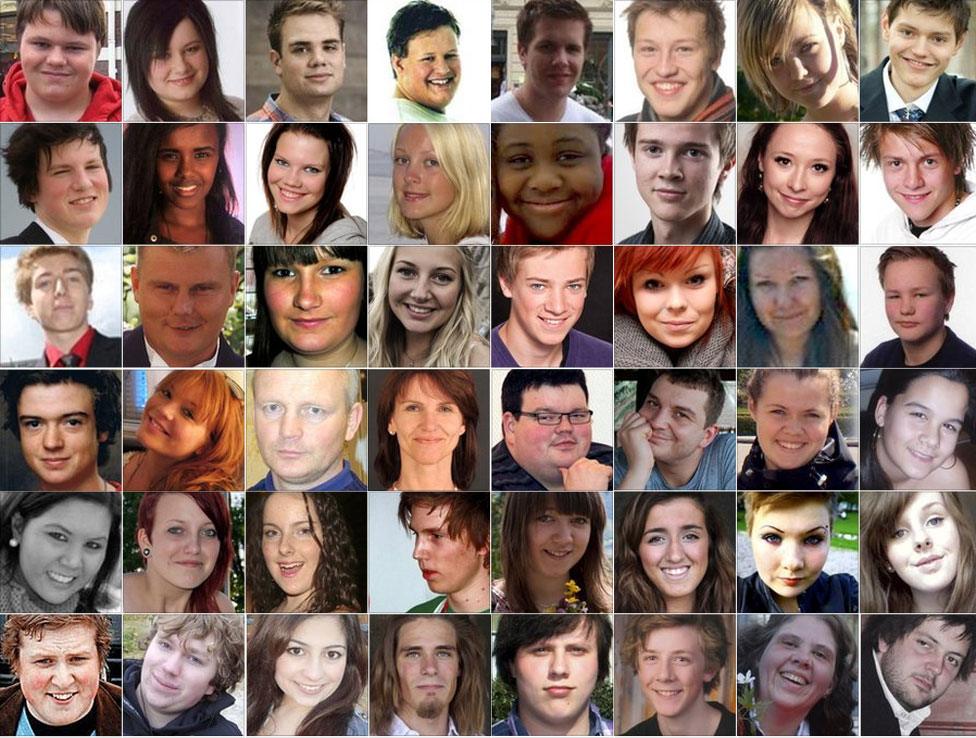
Who Were the 77 Victims?
The Eight Oslo Victims
Eight people died in the Oslo bombing while working or walking through the government quarter on a Friday afternoon. Among them were Hanne Ekroll Løvlie, 30, and Kai Hauge. These victims are sometimes overshadowed by the Utøya massacre, yet their loss was equally devastating.
The 69 Utøya Victims
Sharidyn “Sissi” Svebakk-Bøhn, fourteen, was the youngest person killed on Utøya. Born in New Zealand and raised in Norway, she wrote letters to her local mayor at age twelve asking him not to close a children’s summer camp. In addition, her blog, Purple In Style, offered advice to first-time Utøya campers. Just two days before her death, she posted her last entry on July 20.
Monica Bøsei, 45, dedicated twenty years to organizing the Utøya camp. Her courage in running toward danger to warn others defined her final moments.
Before confronting Breivik, Trond Berntsen, 51, used his last seconds to push his ten-year-old son to safety.
Tore Eikeland, 21, was called “one of our most talented young politicians” by Prime Minister Stoltenberg. Just days earlier, he had spoken at the Labour Party’s national conference.
Bano Abobakar Rashid, 18, came to Norway from Iraq as a child. Through the Labour youth movement, she found community and belonging. As the first victim laid to rest, her coffin was draped in a Kurdish flag.
Silje Merete Fjellbu, 17, was a passionate photographer who captioned a prom photo with “I wish I could look like this every day.”
Thirty-three of the Utøya victims were under eighteen. In contrast, the oldest victim overall was sixty-one. Despite everything, every single person mattered.
How Did Norway Respond to the Attacks?
The Rose March: Choosing Love Over Hatred
In the days following July 22, Norway did not respond with rage or calls for vengeance. Instead, hundreds of thousands of roses appeared across Oslo. Throughout the city, people laid them outside the cathedral, in streets, and at makeshift memorials.
On July 25, approximately 150,000 to 200,000 people gathered in Oslo carrying roses. As a result, it became the largest public gathering in Norwegian history at the time. During this gathering, citizens mourned together and declared that hatred would not divide them.
Prime Minister Stoltenberg’s Response
Prime Minister Jens Stoltenberg, who lost personal friends on Utøya, addressed the nation with words that resonated worldwide:
“The Norwegian response to hatred is more democracy, more openness, and greater political participation.”
He did not call for restrictions on civil liberties. Furthermore, he did not scapegoat communities. Instead, he called for more of exactly what Breivik tried to destroy.
The Gjørv Report and Accountability
The government commissioned an official review. When released, the 2012 Gjørv Report concluded that police could have prevented the bombing and reached Utøya faster. With better coordination, casualties could have been reduced.
Norway took these findings seriously. Subsequently, changes were implemented through legitimate, transparent channels. As a result, accountability was pursued without abandoning core values.
Utøya Today
The AUF continues to hold its annual summer camp on Utøya. Since the attacks, many survivors became politicians, activists, journalists, and human rights advocates. In addition, several have spoken publicly about returning to the island, refusing to let it be defined only by horror.
What Was the Legal Outcome?
The Trial
Breivik’s trial took place between April 16 and June 22, 2012, in Oslo District Court. Although he admitted to both attacks, he denied criminal guilt, claiming self-defense of his culture.
Two teams of forensic psychiatrists evaluated him. Initially, the first diagnosed paranoid schizophrenia. However, a second evaluation concluded he was not psychotic during the attacks. Instead, psychiatrists determined he had narcissistic personality disorder and antisocial personality disorder.
The Verdict and Sentence
On August 24, 2012, the court found Breivik legally sane, convicted him on all charges, and sentenced him to twenty-one years of preventive detention. This represented the maximum civilian penalty under Norwegian law, with the possibility of indefinite five-year extensions for public safety.
Breivik remains imprisoned at Ringerike Prison. Since his incarceration, he has sued the Norwegian government multiple times, claiming his prison conditions violate his human rights under the European Convention on Human Rights. However, every case has ultimately failed.
In 2017, he legally changed his name to Fjotolf Hansen.
Understanding the Psychology Behind the Attacks
How Does Someone Become a Mass Murderer?
Radicalization rarely happens overnight. Because of this, research shows it typically involves a slow process fed by isolation, perceived grievance, and online communities that validate extremist thinking. Over several years, Breivik spent time in this spiral, consuming far-right ideology online without intervention.
He was not someone who “snapped.” Rather, he methodically planned for years until ideology consumed him entirely.
Warning Signs That Were Missed
Childhood psychological reports documented Breivik’s troubled upbringing and his mother’s severe abuse. When he was four years old, experts recommended foster care. Despite these recommendations, authorities did not act on them.
As an adult, Breivik purchased large quantities of fertilizer through his fake farming company. In addition, he made online posts about extremist views. Although Norwegian intelligence placed him on a watch list after his Polish purchases, they did not act because they deemed his activities irrelevant to terror concerns.
These missed warning signs haunt investigators and policymakers still.
Narcissistic and Antisocial Personality Disorders
Psychiatrists diagnosed Breivik with narcissistic personality disorder and antisocial personality disorder. These conditions manifested in his grandiose sense of mission, lack of empathy, and willingness to cause massive suffering to achieve ideological goals.
He viewed himself as a crusader saving European civilization. As a result, this delusion allowed him to rationalize murdering children.
The Role of Online Radicalization
Breivik spent years in online forums consuming and spreading extremist content. Throughout his manifesto, he cited numerous far-right sources and conspiracy theories. Consequently, he exemplifies how isolated individuals can radicalize through internet echo chambers without face-to-face contact with extremist groups.
This pattern continues to challenge governments and social media platforms today.
Understanding Does Not Mean Excusing
Examining Breivik’s psychology does not excuse his actions. Although understanding how radicalization occurs can help prevent future attacks, Breivik made deliberate choices. Over several years, he methodically planned mass murder. Because of their political beliefs, he targeted children.
The responsibility lies entirely with him.
Frequently Asked Questions
How many people died in the 2011 Norway attacks?
Seventy-seven people died as a direct or indirect result of the attacks. Specifically, eight people were killed in the Oslo bombing, and 69 died on Utøya island. The youngest victim was fourteen years old, and the oldest was sixty-one. In addition, more than 320 people sustained injuries, with many suffering lasting physical and psychological trauma.
Why did Anders Behring Breivik target Utøya island?
Breivik specifically chose Utøya because it hosted the Workers’ Youth League summer camp. In his view, he saw the Labour Party as responsible for Norway’s immigration policies and multiculturalism. By targeting young Labour Party members, he aimed to destroy the next generation of politicians who would continue policies he opposed. Furthermore, his manifesto explicitly stated this rationale.
What is Anders Behring Breivik’s current status?
Breivik remains imprisoned at Ringerike Prison in Norway, serving a twenty-one-year preventive detention sentence with the possibility of indefinite extensions. Since his incarceration, he has filed multiple lawsuits against the Norwegian government claiming human rights violations regarding his prison conditions. However, all legal challenges have ultimately failed. In 2017, he legally changed his name to Fjotolf Hansen.
How did Norway change after the 2011 attacks?
Norway implemented security improvements based on the Gjørv Report’s findings while maintaining its commitment to openness and democracy. As a result, the country strengthened police response protocols and coordination. However, Norway rejected sweeping restrictions on civil liberties or scapegoating of communities. In 2021, Norway banned all semiautomatic weapons. In addition, the attacks sparked ongoing discussions about online radicalization and extremism prevention.
Watch the Full Story
For a deeper exploration of the 2011 Norway attacks and the remarkable way Norway chose love over hatred, watch the complete documentary-style coverage on the Crime and Psyche YouTube channel. Throughout the video, the examination covers the psychological dimensions of radicalization, the stories of survivors, and Norway’s unprecedented response to tragedy.
Sources
- Wikipedia: 2011 Norway Attacks
- Wikipedia: Anders Behring Breivik
- Britannica: Mass Shooting
- Norwegian government reports and court documents
- International news coverage from BBC, CNN, and Norwegian media outlets
Why Norway’s Response Still Matters Today
Fourteen years later, the 2011 Norway attacks remain the deadliest assault on Norwegian soil since World War II. Yet Norway’s response offers a blueprint that stands in stark contrast to how many nations react to terrorism.
Prime Minister Stoltenberg could have called for revenge. Alternatively, he could have restricted freedoms or targeted communities. Instead, he called for more democracy, more openness, and more of what makes Norway itself.
The survivors could have abandoned politics, activism, and public service. However, many became exactly what they intended: leaders, advocates, and voices for positive change. Despite the trauma, they returned to Utøya. As a result, they refused to let hatred win.
Sissi Svebakk-Bøhn spent her last days writing helpful advice for strangers attending a camp she loved. Meanwhile, Monica Bøsei ran toward danger to protect the young people she had served for twenty years. Even as he confronted a killer, Trond Berntsen made sure his son survived. Through Norway’s openness, Bano Rashid found home and community.
These 77 people deserved decades more life. In addition, their families deserved more time with them. Norway deserved to remain the peaceful nation it had been.
Breivik took all of that. However, he could not take Norway’s values. Despite his efforts, he could not make Norway become harder, colder, or more fearful.
That is the lesson. Although hatred can take lives, it cannot take meaning unless we allow it. Even after unimaginable loss, Norway chose love, democracy, and openness.
That choice matters. It mattered in 2011, and it matters now.