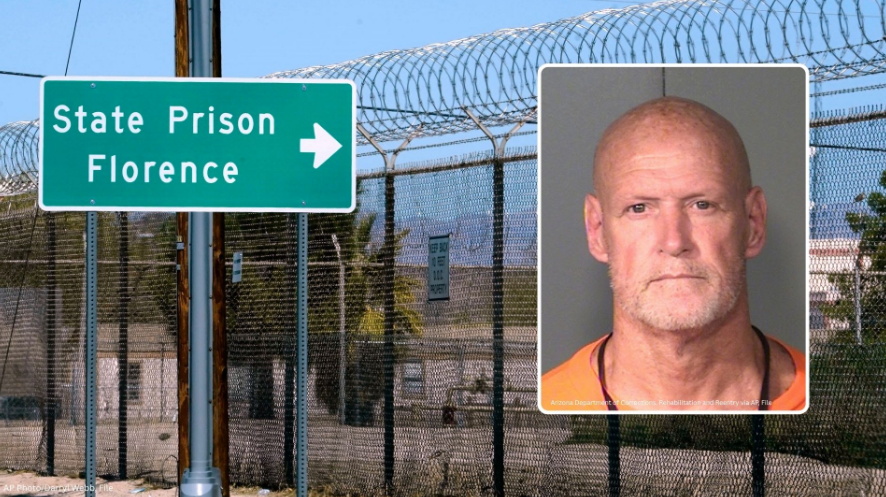

On Wednesday morning, Arizona carried out its first execution of 2026 when Leroy Dean McGill, 63, was pronounced dead at 10:26 a.m. PT following a lethal injection. The execution marked the conclusion of a case where Arizona executes inmate convicted of killing another man set on fire in a 2002 attack that shocked the Phoenix community and left one man dead and his girlfriend severely burned.
Charles Perez died after McGill doused him and his girlfriend Nova Banta with gasoline before igniting them in a north Phoenix apartment. The brutal attack stemmed from accusations that McGill had stolen a gun from the residence. After more than two decades of legal proceedings and appeals, justice was finally administered at the Arizona State Prison Complex in Florence.
The execution proceeded smoothly according to corrections officials, with McGill’s final words expressing gratitude: “I just want to thank everyone for being so accommodating and nice.” Media witnesses reported that McGill appeared calm and even smiled at witnesses before the pentobarbital injection began.
What Happened on July 13, 2002?
The Deadly Attack That Claimed One Life
The violent incident occurred on a summer evening in a north Phoenix apartment where tensions had been escalating. Charles Perez and his girlfriend Nova Banta were sitting on a sofa when they confronted McGill about a stolen firearm.
At the time of the attack, McGill had been using methamphetamine and hadn’t slept for several days. According to trial testimony, McGill told the couple not to “talk behind people’s backs.” Before they could respond, he threw gasoline on them and lit a match.
Perez and Banta immediately ran from the apartment engulfed in flames. Another resident used a blanket to extinguish the fire on Banta, but not before she suffered third-degree burns covering three-quarters of her body. Perez was transported to a hospital where he died after experiencing what prosecutors described as extreme pain.
The fire also endangered other residents who were forced to flee both the apartment and a nearby unit where flames had spread.
How Did the Legal Case Unfold?
Swift Conviction in October 2004
The legal proceedings moved relatively quickly for a capital case. In October 2004, jurors deliberated for less than one hour before convicting McGill on multiple charges including first-degree murder, attempted murder, arson, and endangerment.
Nova Banta testified at trial, identifying McGill as the attacker and providing crucial eyewitness testimony about the events leading up to the attack. Her survival and willingness to testify proved instrumental in securing the conviction.
The same jury that convicted McGill also imposed the death sentence, rejecting defense arguments about his troubled background.
Last-Ditch Appeals Rejected in Spring 2026
McGill’s defense attorneys made several attempts to spare his life in the months leading up to the execution. They presented evidence of severe childhood abuse, mental impairment, and psychological immaturity as mitigating factors.
In spring 2026, his lawyers filed a final petition seeking resentencing, which a lower-court judge rejected. The Arizona Supreme Court subsequently declined a request to postpone the execution. McGill himself waived his right to seek clemency, effectively abandoning his final avenue for avoiding the death penalty.
Who Was Leroy Dean McGill?
Leroy Dean McGill spent more than two decades on Arizona’s death row following his 2004 conviction. Born in the early 1960s, McGill’s defense team documented a childhood marked by abuse and trauma.
At the time of the 2002 attack, McGill was deep in methamphetamine addiction. He had been awake for several days due to drug use, a factor that likely contributed to his impaired judgment and violent behavior. However, neither his substance abuse nor his difficult upbringing ultimately persuaded jurors to spare his life.
For his final meal, McGill requested onion rings, bread and butter, chocolate cake, and a green salad—a modest selection that corrections officials honored.
What Are the Key Facts About This Case?
- Victim: Charles Perez died from severe burns after being set on fire
- Survivor: Nova Banta suffered third-degree burns over 75% of her body
- Conviction date: October 2004
- Time on death row: Approximately 22 years
- Method of execution: Lethal injection using pentobarbital
- Execution time: Less than 25 minutes from IV insertion to death pronouncement
- Witnesses: Media representatives and corrections officials present
According to NBC News, the execution was carried out without complications, contrasting sharply with Arizona’s troubled execution history.
Where Does Arizona Stand on Capital Punishment?
Arizona has had a complex relationship with the death penalty in recent years. The state paused executions for nearly eight years following criticism that a 2014 execution was badly botched.
In that notorious case, Joseph Wood was injected with 15 doses of a two-drug combination over two hours, causing him to snort and gasp hundreds of times before dying. The incident sparked widespread criticism and legal challenges that halted executions.
Arizona resumed carrying out death sentences in 2022, executing three inmates that year. In 2025, the state executed Richard Kenneth Djerf for killing four members of a Phoenix family in 1993 and Aaron Gunches for the 2002 shooting death of his girlfriend’s ex-husband.
With McGill’s execution, Arizona now has 108 prisoners remaining on death row. The state has refined its execution protocol to use two syringes of pentobarbital, a powerful sedative that has proven more reliable than previous drug combinations.
What Did Officials Say About the Execution?
Statements from Prosecutors and Witnesses
Arizona Attorney General Kris Mayes, whose office advocated for the execution to proceed, issued a statement focusing on the victims: “My thoughts today are with the family and the loved ones of Charles Perez and Nova Banta.”
Maricopa County Attorney Rachel Mitchell provided a more detailed response: “After more than two decades, justice was finally served for Charles Perez and the woman who survived this horrific attack. What Leroy McGill did—pouring gasoline on the victims and setting them on fire—was among the cruelest acts imaginable.”
Media witness Sean Rice from Phoenix television station KPNX observed that the execution proceeded smoothly: “That process went swimmingly. I didn’t see any issue at all finding a vein on either arm.” He noted only slight twitching on the right side of McGill’s head about four minutes before death was pronounced.
John Barcello, deputy director of the Arizona Department of Corrections, Rehabilitation and Reentry, confirmed: “Today’s process went according to plan.”
How Does This Fit Into National Execution Trends?
McGill became the 12th person executed in the United States in 2026. His execution on Wednesday was the first of three scheduled that week, with Tennessee and Florida each planning to carry out death sentences on Thursday.
Capital punishment continues to decline nationally, with fewer states actively carrying out executions and growing concerns about the ethics and reliability of lethal injection protocols. However, states like Arizona, Texas, Florida, and Oklahoma continue to maintain active execution schedules.
The smooth execution of McGill stands in contrast to several problematic executions in recent years that have renewed debates about whether lethal injection constitutes cruel and unusual punishment.
If you’re interested in understanding the deeper psychological factors behind cases like this, subscribe to the Crime and Psyche YouTube channel where we explore true crime through a psychological lens, examining what drives individuals to commit violent acts and the warning signs that often precede tragedy.
Sources
- Associated Press reporting from Florence, Arizona
- Arizona Department of Corrections, Rehabilitation and Reentry official statements
- Maricopa County Attorney’s Office
- Arizona Attorney General’s Office
- Media witness accounts from Phoenix news outlets
The Psychology Behind Fire as a Weapon
What Drives Someone to Use Fire in an Attack?
The use of fire as a murder weapon reveals disturbing psychological dimensions that distinguish this crime from other forms of violence. Setting another human being on fire represents one of the most brutal and painful methods of causing death, suggesting either profound emotional detachment or intense rage that overrides normal inhibitions against causing suffering.
In McGill’s case, several psychological factors converged to create conditions for this horrific act. His methamphetamine use and sleep deprivation for several days would have severely impaired his executive functioning—the brain’s ability to control impulses, assess consequences, and regulate emotions. Stimulant psychosis can produce paranoia, aggression, and dissociative states where perpetrators feel disconnected from reality.
The Role of Substance Abuse and Psychological Impairment
Methamphetamine fundamentally alters brain chemistry, particularly affecting the prefrontal cortex responsible for judgment and the amygdala involved in emotional regulation. Chronic use leads to cognitive deficits, emotional volatility, and sometimes paranoid delusions. When combined with sleep deprivation—essentially another form of torture to the brain—the result can be catastrophically impaired decision-making.
Defense attorneys highlighted McGill’s childhood abuse and mental impairments, factors that research consistently links to increased violence risk. Adverse childhood experiences reshape neural development, particularly in regions governing emotional regulation and stress response. However, the jury ultimately concluded these factors didn’t excuse the extreme cruelty of his actions.
Understanding the Victim Selection and Triggering Event
The attack was precipitated by accusations of theft—a perceived slight to McGill’s reputation or integrity. In his drug-impaired, sleep-deprived state, this confrontation may have triggered disproportionate rage or paranoid thinking. The statement “don’t talk behind people’s backs” suggests preoccupation with betrayal or disrespect.
Fire as a weapon choice is particularly revealing. Unlike shooting or stabbing, setting someone ablaze requires sustained action: obtaining gasoline, positioning oneself, throwing the accelerant, and lighting the match. This sequence suggests some degree of planning, even in an impaired state, contradicting claims of purely impulsive action.
The Lasting Impact on Survivors
Nova Banta’s survival came at tremendous cost. Third-degree burns over 75% of her body would have required extensive surgeries, skin grafts, and years of painful recovery. Beyond physical scars, survivors of such attacks typically experience severe PTSD, survivor’s guilt, and permanent psychological trauma.
Her testimony at trial demonstrated remarkable courage. Facing one’s attacker requires confronting not just the person but the horrific memories of the attack itself. Such testimony provides critical closure for some survivors while being retraumatizing for others.
Warning Signs and Prevention
This case illustrates the dangerous intersection of substance abuse, mental health issues, and interpersonal conflict. Warning signs included McGill’s escalating drug use, prolonged wakefulness, and involvement in property crime (the alleged gun theft). Friends or family might have noticed increasing paranoia, agitation, or disconnection from reality.
Methamphetamine addiction rarely resolves without intervention. The psychological changes it produces—including increased aggression, paranoia, and impulsivity—create conditions where violence becomes more likely, especially during confrontations.
Conclusion: Justice After Two Decades
The execution of Leroy Dean McGill closed a chapter on one of Arizona’s most brutal murder cases, but it cannot undo the suffering inflicted on Charles Perez and Nova Banta. Perez died in unimaginable agony, while Banta survived with permanent physical and psychological scars that she will carry for life.
This case reminds us that behind every criminal justice statistic lies profound human tragedy. While debates about capital punishment’s morality and effectiveness continue, the facts of this case remain stark: a drug-fueled attack resulted in one death, one survivor left with devastating injuries, and multiple lives forever altered by senseless violence.
The smooth execution contrasts with Arizona’s troubled history with lethal injection, perhaps offering some reassurance that protocols have improved. Yet the fundamental questions remain: Does execution serve justice? Does it deter future violence? Does it provide closure to victims’ families?
What we can say with certainty is that methamphetamine addiction, untreated mental health issues, and easy access to accelerants created conditions for tragedy. Perhaps the most meaningful legacy of Charles Perez would be greater investment in addiction treatment, mental health services, and violence prevention—measures that might stop the next tragedy before it occurs.
Maricopa County Attorney Rachel Mitchell expressed hope that the execution would bring “some measure of peace” to those affected. After 23 years, Nova Banta and Charles Perez’s loved ones finally witnessed legal accountability, though no punishment can truly balance the scales when a life has been taken so brutally.